
From Assessment to Action: 6 Steps for Diagnostic and Prescriptive Teaching in Dyslexia Intervention
You've followed the lesson plan. You've taught the concept explicitly, modeled it, and given your student time to practice. Yet the same errors keep showing up, in word reading, in spelling dictation, in their writing. You know something isn't clicking, but you're not quite sure what to change. If that sounds familiar, you're not alone. Roadblocks like this are a part of teaching students with dyslexia.
The good news? A roadblock isn't a dead end. It's information. And when we know how to read that information, it tells us exactly where to go next.
I recently had the opportunity to put these ideas into a flyer for Voyager Sopris, Empowering Students With Dyslexia: Using Diagnostic and Prescriptive Teaching To Navigate Roadblocks. In this post, I want to walk you through the heart of it: a framework I call the Assessment-to-Action Cycle. You can download the full flyer here to keep the visual of the cycle close by as you plan.
Why It Matters
Dyslexia is a language-based learning disability characterized by difficulties in reading, spelling, and writing. It exists on a continuum, which means our students show up with very different profiles of strengths and needs. Two students with dyslexia in the same small group may be stuck for completely different reasons.
Because of that variability, effective instruction can't rely on a single strategy or a scripted response. It requires us to bring together evidence-based practice and the art of teaching. That is exactly what diagnostic and prescriptive teaching does.
So what do those terms mean?
- Diagnostic teaching means we continuously monitor a student's verbal, nonverbal, and written responses, gathering both qualitative and quantitative data to identify and analyze problems and progress, specifically noting patterns of strengths and needs.
- Prescriptive teaching means we use that information to design actionable steps that address the identified pattern of need, so our instructional decisions are planned and purposeful.
Together, they keep instruction intentional, responsive, and focused on the student rather than on simply getting through the next page of the program.
The Assessment-to-Action Cycle
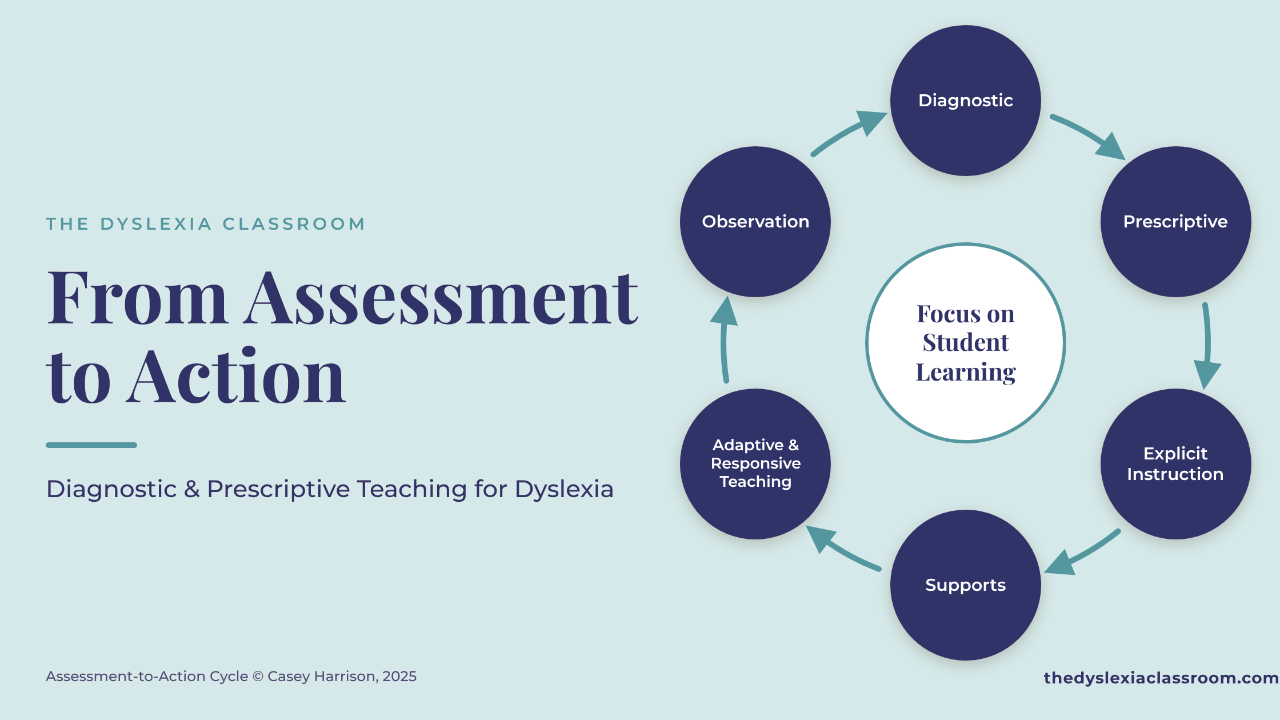
Diagnostic and prescriptive teaching is not linear. It isn't "test, then teach, then move on." It is a dynamic cycle that we continually refine based on how our students respond. At the center of the cycle is the reason we do any of this: a focus on student learning.
The cycle has six parts. Let's walk through each one.
Step 1: Diagnostic – Look for Patterns, Not Isolated Errors
Diagnostic teaching begins with assessment, but it extends beyond it. Formal assessments are important, but daily observation, student work samples, verbal responses, and written output give us a much fuller picture of how a student processes language and print.
The key shift here is looking for patterns rather than isolated errors. One misread word doesn't tell us much. An error that repeats across reading, spelling, and writing tasks tells us a lot. Our goal isn't just to name an area of need. It's to understand why the errors are happening and how we can adjust instruction to move the student toward mastery.
Step 2: Prescriptive – Design Your Instructional Action
Prescriptive teaching is our instructional response to what we noticed. Once we've identified a pattern of need, we plan purposeful strategies aligned to it. That might mean deciding when to explain a concept, reteach, model a strategy, provide more practice, modify scaffolding, pose questions, clarify understanding, give feedback, or use retrieval practice.
Now, here's a common misconception: prescriptive teaching does not mean writing an individualized lesson for every single student. Instead, it means adjusting focus, pacing, and instructional emphasis within an evidence-based framework. That keeps our teaching precise and keeps us from falling back on generalized instruction. Your knowledge of literacy development, keen observation, and ability to analyze student learning are what guide these next steps.
Step 3: Explicit Instruction – Teach With Clarity
Students with dyslexia benefit from explicit, systematic instruction, which is at the core of a Structured Literacy approach. In this part of the cycle, we implement evidence-based instruction with the right supports and plenty of opportunities for practice. Explicit instruction provides the clarity. Practice is where we get to see what our students do with it.
Step 4: Supports – Extended Guided Practice and Intentional Scaffolds
If I could highlight one moment in the lesson, it would be extended guided practice. This is where diagnostic and prescriptive teaching most clearly meet. As students apply a skill, we're watching, giving immediate corrective feedback, and adjusting instruction in the moment. We stay responsive without losing structure or our focus on learning outcomes. This is also where we adjust pacing, grouping, and intensity based on how students are performing.
Scaffolds play a big role here. A scaffold is a temporary support that gives students access to instruction while we maintain high expectations. (If you'd like specific ideas for decoding, my post Stuck on Decoding? 5 Ways to Scaffold Instruction walks through several.) Effective scaffolding:
- Is aligned to identified patterns of need
- Targets one instructional focus at a time
- Is temporary and responsive
- Is released as accuracy and automaticity develop
Step 5: Adaptive and Responsive Teaching – Adjust in Real Time
Adaptive, responsive teaching uses ongoing formative assessment and checks for understanding to make real-time adjustments, both before and during lessons. We clarify misconceptions, refine instruction, and address learning needs as they come up. High expectations stay constant, while supports shift through strategic scaffolding, explicit modeling, and targeted feedback.
As students show readiness, we systematically fade scaffolds across modeling, guided practice, and supported independence. (I take a closer look at this gradual fading in From Effortful Decoding to Automatic Word Reading.)
Step 6: Observation – Reflect, Release, and Reassess
Finally, we use reflection and observation to modify and adjust support. As we release supports, we prepare to reassess, and the cycle begins again with fresh diagnostic information. Each time through, our instruction becomes a little more precise.
Where the Art of Teaching Meets Evidence-Based Practice
The Assessment-to-Action Cycle shows how diagnostic and prescriptive teaching connect evidence-based practice with the art of teaching. Research gives us the foundation: explicit instruction, a Structured Literacy approach, and cumulative practice. We, as teachers, bring that foundation to life through observation, expertise, and adaptive decision-making.
When we fully engage in this cycle, instruction becomes more precise, students experience meaningful success, and learning moves forward with clear intention. That roadblock you're facing? It's your next data point. The cycle helps us turn awareness into effective instructional action, one informed decision at a time.
Want to Learn More?
- Download the flyer: Download the full flyer, Empowering Students With Dyslexia: Using Diagnostic and Prescriptive Teaching To Navigate Roadblocks, including the full Assessment-to-Action Cycle graphic.
- Watch the webinar: Catch the Empowering Readers With Dyslexia: Using Diagnostic and Prescriptive Teaching To Navigate Roadblocks webinar, along with other sessions on demand, at www.voyagersopris.com/dyslexia-week.
- Go deeper: In my book, Teaching Beyond the Diagnosis: Empowering Students With Dyslexia, I share an integrated framework for understanding and supporting students with dyslexia in all its complexity.
Which part of the cycle do you find yourself spending the most time in? I'd love to hear how you're turning assessment into action with your students. And if you haven't already, I invite you to join The Dyslexia Classroom community and subscribe to access the freebie library for resources, tips, and updates to support your learners.

Hey there!
My name is Casey Harrison
Welcome to The Dyslexia Classroom's blog. I'm a Certified Academic Language Therapist, Dyslexia Therapist, and creator of The Dyslexia Classroom. My passion is to help educators and parents understand their dyslexic learners to help them reach their fullest potential. I'm glad you are here!
Recent Posts

Join The Dyslexia Classroom!
Subscribe to access the freebie library and be the first to know about courses, resources, updates, tips and more!
Categories
All Categories